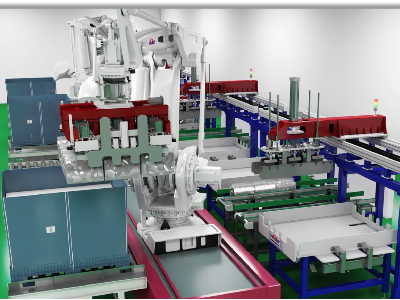
Automated Packaging Line As core equipment for the post-manufacturing process, it has a direct impact on product packaging quality, production efficiency, and labour costs. Product packaging in industries such as chemicals, new energy, etc. often involves special requirements such as heavy loads, preservation, dust protection, etc. The selection and implementation are more important.
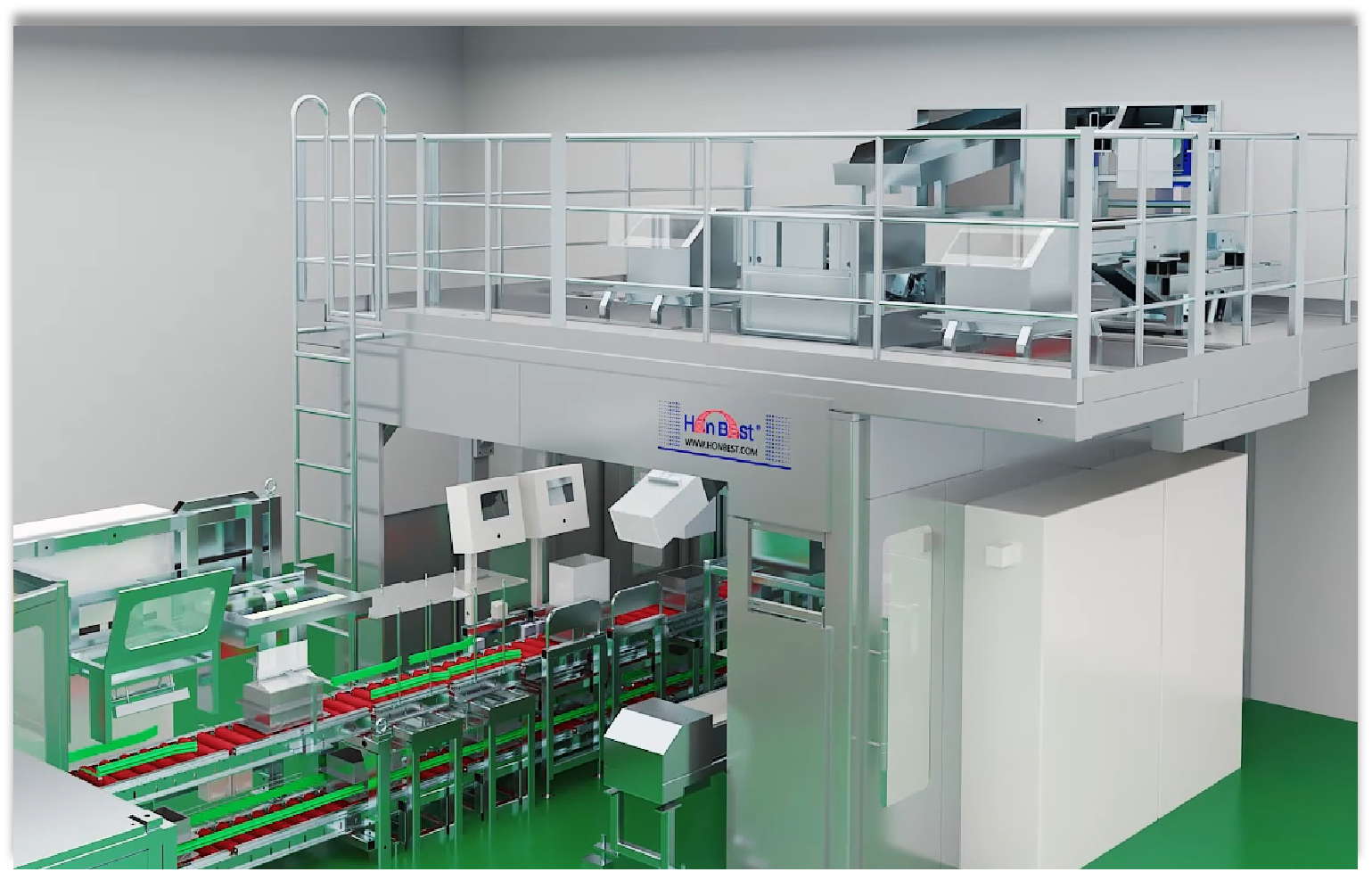
What processes and equipment do automatic packaging production lines typically contain?
A complete automated packaging production line typically contains the following processes and equipment:Previous PhaseThese include product sorting agencies, automatic boxing agencies (or robotics) and sealers;Medium Phase ProcessThese include automatic stickers (support for real-time printing of stickers), automatic packers (PET straps), auto-tanger machines (tangled membranes);Next PhaseIncludes robotic coding machines, automatic transmission lines (stranglers/belts/chainboards), back-up lift machines (cross-storey);Support equipmentThe configuration needs to be customized according to product characteristics, packaging forms, and capacity needs.
How should the capacity of automatic packing lines be matched and designed?
Packaging line energy designs need to take into account the following factors:One is the front line capacity.Packaging line capacity needs to be greater than or equal to the lower of the front end of the production line to avoid capacity bottlenecks;Two is the peak capacity requirement.Need to consider peak capacity needs during the production season and the concentration period of orders;Three is the rate of plant activity.Actual capacity = theoretical capacity x equipment crop rate, usually designed at 85-90 per cent crop rate;Four is the product specification switch.For multi-SKU production, the effects of switching time and frequency are to be considered for capacity;Five is reserved for expansion.It is proposed to set aside 10-20% of capacity redundancy to facilitate future expansion.
What's the advantage of robotics and traditional methods?
The robotic coding has the following advantages over the conventional coding and mechanical coding machines:One is soft.Industrial robots can be programmed in multi-coded models, multi-product specifications, remodelled quickly and suitable for multi-SKU production;Two is precision.The robot repositions with high precision, well-defined norms, and well-stabilized;Three is a strong carrying power.A robot with different loads, depending on the weight of the product, is suitable for light to heavy load;Fourth is the flexibility of the land.A robot can be installed on the side or at the end of the production line in a flexible layout suitable for a workshop with limited space;Five is highly reliable.On average, industrial robots have a long time without failure, and maintenance costs are low enough to support 24-hour continuous operation. Robotic codes are a better option for situations with multiple product specifications, complex coding patterns, and possible future expansions.
Can the automatic packing line match the front-end production line, the back-end automated high-bay warehouse?
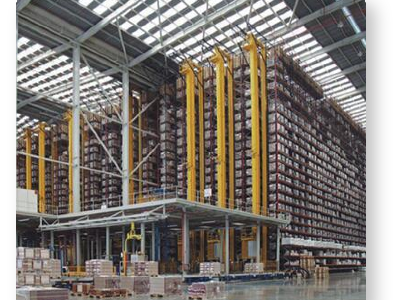
Yes. Automatic packing lines are key links to front-end production lines and back-end stereo storage:Front-end ConsoleFor packaging lines to be integrated in production-packaging by directly connecting the line of transmission to the lower end of the line of production, and automatically entering the line of packing and containerization processes after the line of production;Backend ConsoleThe finished packaged finished product is automatically transported through the conveyor line, lifter, AGV etc. to the automated high-bay warehouse entrance to enable automatic input of the finished product to the WMS/WCS system;System dockingThe packaging line control system is interfaced with the enterprise MES and WMS systems to achieve real-time synchronization of production orders, packaging data, and inventory data.
What are the special requirements for packaging lines in the chemical and new energy industries?
Specific requirements for product packaging in the chemical and new energy industries are often as follows:One is the reloading requirement.Chemical products are mostly 25 kg/bags, 50 kg/bags or even tons of bags packed with large single-box loads requiring strong equipment carrying capacity and robust structures;Two is the preservation requirement.Corrosive products or corrosive environments require the use of preservative materials, preservative coatings, stainless steel components;Three is dust-proof.In the dust workshop, dustproofing equipment, sealed electrical cabinets, dustproofing masks are required;Four is blast-proof.The packaging area for flammable and explosive products requires the use of explosive electrical equipment;Five is a continuous production requirement.The chemical industry is mostly a continuous production industry, and equipment needs to be supported to operate on a 24-hour basis, with high reliability;Six is an environmental requirement.It is recommended that suppliers with experience in the chemical industry’s new energy sector be selected to ensure that the programme is in line with industry performance and regulations.
How long is the implementation cycle of the automatic packing line generally? What are the stages involved?
The implementation cycle of the Automatic Packaging Lines project is typically 3-6 months and consists of the following phases:Programme design phase(2-3 weeks), on-site survey, product packaging test, programme design, layout drawing output;Production stage(6-12 weeks), manufacture of equipment, commissioning of plant assembly;On-site installation phase(2-4 weeks), installation of equipment on site, electrical connection, pipe connection;Try the running phase.(1-3 weeks) Electromagnetic coupling, tape commissioning, rhythm optimization, operational training;Receiving and inspection delivery phaseFor large-scale projects that include multiple packing lines, stereo-bank interfaces, and information integration, the implementation period may take 6 to 9 months. It is recommended that sufficient implementation time be set aside at the project planning stage to ensure that the project is on schedule.
What does the routine maintenance of automatic packing lines require attention?
The daily maintenance of automatic packing lines is recommended as follows:- A routine checkup.(b) Before each flight starts, check the state of the equipment, the pressure of the gas source, the state of the sensor, the state of the safety shield, with attention to the sound and state of the operation of the equipment in operation;Second, regular lubrication.(b) Periodic lubrication maintenance of motor parts, bearings, chains and tracks as required by the equipment specifications;Third is the replacement of vulnerable items.periodic inspection of vulnerable items such as belts, chains, seals, knives, straws, etc., and timely replacement of worn parts;Four is cleaning maintenance.Regular cleaning of equipment surfaces, sensors, PV switches and maintenance of equipment cleaning, particularly in the chemical dust environment, needs to be improved;Five is electrical maintenance.Regular checks of electrical connections, contacts, relays, PLC program backups to ensure the stability of the electrical system;Six is regular inspection.It is recommended that vendor professionals conduct comprehensive inspection and maintenance inspections on a quarterly or semi-annual basis to screen for potential hazards. A well-developed equipment maintenance system is in place to effectively extend the useful life of the equipment and reduce the failure rate.
How can the return on investment in automatic packing lines be assessed?
The return on investment in automatic packing lines can be assessed in the following dimensions:One is labour cost savings.(b) Automation of packaging to replace posts such as manual boxes, seals, stickers, coding, handling, etc., with a significant reduction in manual inputs and annual savings at local per capita cost;Second, package quality upgrades.(b) Harmonization of automated packaging to reduce problems such as irregularities in manual packaging, deterioration of goods, leakages, etc., and to reduce packaging wear and tear and passenger litigation costs;Third is productivity improvement.Packaging lines are operating consistently and steadily, resulting in increased output and increased order delivery capacity;Four is a reduction in management costs.Digital management reduces the volume of manual statistics, manual billboards, manual inventory, etc.;Five is security risk reduction.Automation operations reduce the risk of safety accidents involving manual handling of heavy loads and manual handling of hazardous equipment. Generally, the investment recovery period for automatic packing line projects is around two to four years, with faster returns for industries with high workloads and difficulties.
Access to exclusive packing lines
When planning to build automatic packaging production lines, we can contact for free on-site survey and programme design services.
Service coverage: free on-site survey Design Custom program Delivery of whole line installation Long-term transport security


 Service Hotline
 Honbest